Health Insurance 101: The Complete Guide for International Students
.jpg)
ISO Customer Care | Nov 02, 2026 Insurance
The U.S. health care system can be confusing, especially if you're used to how things work in your home country. This guide brings together everything you need to know about using your health insurance as an international student, from understanding how your plan works to seeing a doctor, picking up a prescription and handling a claim.
You don't need to read it all at once. Use the sections below to jump to what you need, and come back whenever you have a question.
Need help now? If you're having a medical emergency, call 911 or go to the nearest emergency room.
- ISO customer care: (800) 244-1180 · customercare@isoa.org
- Claims questions (SISCO Benefits, ISO's claims department): 833-577-2586 · ISOservice@siscobenefits.com
- Your ID card and plan documents: Log in to your ISO account
1. How U.S. Health Insurance Works
In many countries, the government pays for most health care. In the U.S., most people rely on private health insurance. You pay a regular amount for your plan, called a premium, and in return your insurance pays a large share of your medical costs when you need care.
Your plan is a PPO
All ISO plans are PPO (Preferred Provider Organization) plans. A PPO works with a network of doctors, hospitals and clinics that have agreed to charge lower, discounted rates to members.
- In-network providers have an agreement with your plan's network, so your visit costs less and billing is simpler.
- Out-of-network providers don't have that agreement. A PPO still lets you see them, but you'll usually pay more, and you may need to pay upfront and file a claim yourself.
Your ISO plan works with the Aetna PPO network.
Tip: Choose in-network providers whenever you can. It's the simplest way to save money on care.
What you pay, and when
Even with insurance, you'll usually share some of the cost of your care. Here's how it typically works:
- Premium: What you pay for your plan, whether or not you use it.
- Copay: A set fee you pay for certain services, such as a doctor's visit. It's usually paid at the appointment, and it doesn't count toward your deductible.
- Deductible: The amount you pay before your insurance starts paying its share. Some plans have a deductible per policy year, and some have one per injury or sickness.
- Coinsurance: After the deductible, the percentage of the cost you pay. For example, with 20% coinsurance, your plan pays 80% and you pay 20%.
- Out-of-pocket maximum: The most you'll pay for covered care during your policy period. After you reach it, your plan pays 100% of covered costs.
These amounts are different for every plan. You can find yours in your plan brochure or on your ID card.
An example, for illustration only: Say you visit an in-network doctor, and your plan has a $30 copay, a $500 deductible per policy year, and 20% coinsurance.
You pay the $30 copay at your visit. Then, if the rest of the eligible bill is $700 and you haven't met your deductible yet, you pay the first $500. Of the remaining $200, your plan pays 80% ($160) and you pay 20% ($40).
In total, you pay $570 ($30 + $500 + $40), and your plan pays $160.
What insurance usually doesn't cover
Every plan has exclusions (services it doesn't cover) and limitations (rules on how much or how often it covers something). Common examples include routine dental and vision care, cosmetic procedures and some pre-existing conditions. Always check your plan brochure before a planned procedure, so there are no surprises.
2. Your Insurance Documents and ID Card
When you buy an ISO plan, you'll get a confirmation email with your insurance documents. Keep them somewhere easy to reach, like your phone, so you have them in an emergency. You can also download them anytime from your ISO account, where you log in with your member ID or email and password.
Get familiar with these three documents:
- Insurance ID card: The card you show at every medical visit and at the pharmacy.
- Confirmation letter: Proof of your coverage and your policy dates. Your school may ask for it if you're waiving its insurance.
- Plan brochure: The full details of what your plan covers, what it doesn't, and what you'll pay.
What's on your ID card
Your ID card has everything a doctor's office or pharmacy needs to check your coverage and bill your insurance, including:
- Your name and member ID
- Your plan name and policy dates
- Your PPO network
- Your copay amounts
- The claims department's contact details, mailing address and payer ID
- Pharmacy information (RX BIN, PCN and Group numbers)
Keep your contact details up to date. Claims updates, including your Explanation of Benefits, are sent to the address and email in your ISO account. If you move or change your email, update it in your account right away.
3. Where to Go for Care
A medical provider is any person or place that gives you medical care, such as a doctor, clinic, hospital or pharmacy. Going to the right type of provider gets you the right care faster, and can save you a lot of money.
Start here: two questions
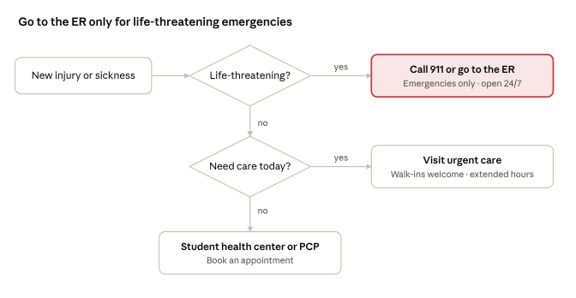
If you're in danger or experiencing a life-threatening emergency, call 911. Otherwise, ask yourself whether you need care today. If you do, urgent care is usually the best choice. If it can wait, book an appointment with your student health center or a primary care doctor.
Types of providers
Student health center (SHC). A clinic on campus for enrolled students, offering basic care and treatment for minor illnesses and injuries. For most students, it's the best first stop, and it's often quicker to get an appointment than with an outside doctor. All student health centers are considered in-network for ISO plans.
Primary care physician (PCP). If you don't have a student health center, a PCP is your best first choice for non-emergency care. PCPs include family medicine doctors, internal medicine doctors and OB/GYNs. You'll need an appointment. A PCP can treat common issues like:
- Headaches and migraines
- Back pain
- Allergies
- Ear infections
- The flu
Specialist. A doctor with advanced training in one area of medicine, such as an allergist (asthma and allergies), cardiologist (heart), dermatologist (skin, hair and nails) or endocrinologist (thyroid and hormones). Specialists usually cost more than a PCP. PPO plans often don't require a referral, but it's best to see your PCP or SHC first for new symptoms, so you see the right specialist.
Urgent care / walk-in clinic. For problems that need care the same day but aren't life-threatening. No appointment is needed, and many are open evenings and weekends. Urgent care is also a good option when your doctor can't see you soon. Go to urgent care for things like:
- Rashes and skin infections
- Minor cuts that may need stitches
- Eye irritation or redness
- Fever, colds and sore throats
- Sprains and minor injuries
Emergency room (ER). For life-threatening conditions only. ERs are open 24/7, but they're the most expensive place to get care, and wait times can be long for non-emergencies. Going to the ER for something that isn't an emergency may cost you much more, and it may not be fully covered. Go to the ER, or call 911, for things like:
- Chest pain or pressure
- Severe trouble breathing
- Signs of a stroke, such as sudden weakness, face drooping or slurred speech
- Serious head injuries or loss of consciousness
- Severe bleeding or burns
- Broken bones that are badly out of place or break through the skin
Laboratories. Labs run tests on blood and other samples, usually when a doctor orders them. Your doctor will tell you which lab to use, so ask for an in-network one.
Pharmacies. Where you pick up prescriptions and over-the-counter medicines. Many pharmacies also offer vaccines, like flu shots. See section 5 for more.
For a printable version, see our ER vs. urgent care infographic.
4. Seeing a Doctor, Step by Step
Step 1: Find an in-network provider
Log in to your ISO account and use the Find Doctors and Hospitals tool to search for providers in your plan's network. You can also ask friends for recommendations or check your school's health center.
When choosing a doctor, think about:
- Location: How easy it is to get there by walking, transit or rideshare.
- Office hours: Whether they're open when you're free.
- Language: Whether the doctor or staff speak your language, or offer an interpreter.
- Credentials and reviews: The doctor's training, experience and what other patients say.
Step 2: Call to make an appointment
Call the office directly. Tell them your plan's PPO network (it's on your ID card) and ask them to confirm they're in-network. It's also a good time to ask whether you'll need to pay anything at the visit, and whether they can bill your insurance directly.
Step 3: Prepare for your visit
- Bring your ID card. You can print a copy or keep the digital version on your phone. The office needs it to check your coverage and send the bill to SISCO Benefits, ISO's claims department.
- Write down your symptoms and questions, so you don't forget anything.
- Bring a list of any medicines you take, including ones from home.
- Ask for an interpreter if you need one. Most U.S. medical offices can arrange one, often at no cost to you.
Step 4: At the appointment
- Be open and honest about how you're feeling. Your doctor is there to help, not judge.
- Ask questions about anything you don't understand, including your diagnosis, treatment and costs.
- Be ready to pay your copay. If your plan has one, you'll usually pay it before you leave.
Some providers, especially out-of-network ones, may ask you to pay the full amount at your visit. If that happens, you can file a claim to be reimbursed. See section 6.
Step 5: After the appointment
Ask the office to confirm they'll submit the claim to your insurance. Then watch for your Explanation of Benefits and your bill, explained in section 6.
5. Prescriptions and Pharmacies
In the U.S., pharmacies sell two kinds of medicine:
- Prescription medicines need an order from a licensed health care provider, such as a doctor or nurse practitioner.
- Over-the-counter (OTC) medicines, like pain relievers, allergy pills and cough syrup, can be bought without a prescription.
Getting a prescription
You'll need to see a provider who can diagnose your condition, such as your student health center, a primary care doctor or an urgent care clinic. They'll send your prescription electronically to the pharmacy you choose. If you want to use a different pharmacy later, ask your doctor's office or the new pharmacy to transfer it.
Ask about generics. Generic medicines have the same active ingredients as brand-name ones but often cost much less. Ask your doctor or pharmacist whether a generic is right for you.
Picking up your medicine
Bring:
- Your name and date of birth, so the pharmacy can match you with your prescription.
- Your insurance ID card. Show the pharmacy the RX BIN, PCN and Group numbers on your card, which they use to process your coverage or discounts.
- A way to pay for your copay or any remaining cost.
Before you leave, check that it's the right medicine, and ask the pharmacist how to take it and about any side effects. Pharmacists are a great free resource for questions.
Managing your medicine
- Take it as directed. Don't skip, double or change doses without asking your doctor or pharmacist.
- Store it properly, in its original container, somewhere cool and dry.
- Refill on time. Check your label for remaining refills, and sign up for your pharmacy's refill reminders. Contact your doctor before you run out if you need a new prescription.
- Dispose of it safely. Many pharmacies offer drop-off boxes for unused or expired medicine.
Bringing medicine from home? Keep it in its original packaging with a copy of your prescription. A U.S. pharmacy can't refill a prescription from another country, so you'll need to see a U.S. provider for a new one.
ISO plans cover prescription drugs for covered injuries and sicknesses. Check your plan brochure for details.
6. Claims, EOBs and Paying Your Bill
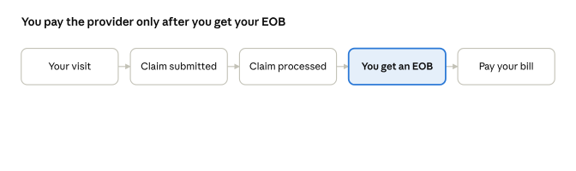
A claim is a request for payment sent to your insurance after you get medical care. It lists what care you received and what it cost. Your insurance reviews it, pays its share, and then the provider bills you for anything left.
Do I need to file a claim myself?
Usually not. Your provider sends the claim directly to SISCO Benefits, ISO's claims department, using the details on your ID card.
In rare cases, often with out-of-network providers, an office may ask you to pay the full amount upfront. If that happens, you can file the claim yourself and be reimbursed for the covered amount.
How to file a claim yourself
- Check with your provider first. At your visit, show your ID card and ask whether they'll submit the claim for you. If they will, you don't need to do anything else.
- Gather your documents. You'll need your payment receipt, if you paid, and an itemized bill. The itemized bill should show the provider's or clinic's name, the date of service, the diagnosis code, the procedure code, the provider's tax ID and the total charge.
- Complete the claim form. Download the claim form and fill it in with details about your visit and treatment.
- Submit everything to SISCO Benefits in one of three ways:
- Online: Log in to your ISO account, go to My Claims, then Claim Submission.
- Email: ISOService@siscobenefits.com
- Mail: SISCO Benefits, PO Box 3190, Dubuque, IA 52004
For more help, see the claims process page.
How long does it take?
Claims are usually processed within 15–30 business days. Once your claim is processed, you'll receive an Explanation of Benefits (EOB) from SISCO Benefits.
Understanding your EOB
An EOB is not a bill. It explains how your claim was handled: what the provider charged, what your plan paid and what you may owe. It's sent to the mailing address and email in your ISO account, and you can also view it anytime in your account under Claims Status.
Always read your EOB. If SISCO Benefits needs more information to finish processing your claim, it will say so in the EOB. You can send the extra documents the same way you'd submit a claim. If you paid upfront and filed a claim yourself, you'll receive your reimbursement with or shortly after your EOB, either by check or by direct deposit (ACH), depending on what you chose on your claim form.
For a line-by-line walkthrough, see Understanding Your Explanation of Benefits.
Paying your bill
After your EOB, the provider will send you a bill for the amount the EOB says you owe. Check that the two amounts match, then pay the provider using the payment details on the bill. If they don't match, call the provider's billing office or SISCO Benefits before you pay.
If you think your claim was processed incorrectly
Start by contacting SISCO Benefits to ask how the decision was made. It's often a simple fix, like missing information. If you still disagree, you can appeal. Email ISOservice@siscobenefits.com with:
- The completed appeal form
- A clear explanation of why you think the decision should change
- Any supporting documents, such as medical records or receipts
For claims or appeals questions, call SISCO Benefits at 833-577-2586.
7. Health Insurance Terms to Know
Claim: A request for payment sent to your insurance after you receive care.
Coinsurance: The percentage of a covered cost you pay after meeting your deductible, for example 20%.
Copay: A fixed fee you pay for certain services, such as a doctor's visit or prescription.
Coverage period (policy period): The dates your plan is active, shown on your confirmation letter.
Deductible: The amount you pay for covered care before your plan starts paying its share.
Emergency room (ER): A hospital department for life-threatening injuries and illnesses, open 24/7.
Exclusions: Services or treatments your plan doesn't cover.
Explanation of Benefits (EOB): A statement showing how a claim was processed: what was charged, what your plan paid and what you may owe. It isn't a bill.
In-network provider: A provider that has an agreement with your plan's network to charge discounted rates.
Inpatient care: Treatment that requires staying in the hospital overnight or longer.
Itemized bill: A detailed bill listing each service, its code and its cost. You'll need one to file your own claim.
Limitations: Rules on how much or how often your plan covers a service.
Maximum benefit: The most your plan will pay, for example per injury or sickness, or during your coverage period. Check your plan brochure for your plan's limits.
Medical evacuation: Transport to the nearest appropriate medical facility in an emergency, or back to your home country when medically necessary.
Out-of-network provider: A provider without an agreement with your plan's network. Care usually costs more.
Out-of-pocket costs: What you pay yourself for care, such as copays, deductibles and coinsurance.
Outpatient care: Treatment you receive without being admitted to a hospital, such as a doctor's visit or same-day procedure.
Pre-existing condition: A health condition you had before your coverage started. Some plans limit coverage for these, so check your brochure.
Policyholder: The person insured under the plan.
PPO (Preferred Provider Organization): A type of plan with a network of providers that offer discounted rates. You can still see out-of-network providers, usually for a higher cost.
Premium: The amount you pay to buy and keep your insurance.
Prescription: An order for medicine from a licensed health care provider, such as a doctor or nurse practitioner.
Primary care physician (PCP): A doctor you see for routine check-ups and common illnesses, and who can refer you to specialists.
Provider: A doctor, clinic, hospital, lab or pharmacy that provides medical care.
Referral: A recommendation from one doctor to see another, usually a specialist.
Repatriation of remains: Transporting the remains of an insured person back to their home country.
Specialist: A doctor trained in one area of medicine, such as cardiology or dermatology.
Urgent care: A walk-in clinic for non-life-threatening problems that need same-day care.
Your Health Insurance Checklist
- ☐ Save your insurance ID card on your phone
- ☐ Read your plan brochure, especially your copays, deductible and exclusions
- ☐ Find your nearest student health center, in-network doctor and urgent care before you need them
- ☐ Keep your address and email up to date in your ISO account
- ☐ Save the ISO and SISCO Benefits phone numbers in your contacts
- ☐ Know when to go to the ER, and when urgent care is the better choice
We're Here to Help
The U.S. health care system takes some getting used to, but you don't have to figure it out alone. If you have questions about your coverage, contact ISO customer care at (800) 244-1180 or customercare@isoa.org. For claims questions, contact SISCO Benefits at 833-577-2586 or ISOservice@siscobenefits.com.
With an ISO plan, you can see doctors in all 50 states and get coverage designed for international students. Explore ISO plans to find the right coverage for your time in the U.S.